
This content may contain affiliate links. If you purchase through these links I may receive a commission at no extra cost to you. However, I only recommend products or services that I genuinely like and trust.
Hyphens are one of the trickiest punctuation marks. (I know, I’ve said the same thing before about other punctuation marks. They’re all tricky! ;-))
The biggest issue with hyphens is that often whether you use one or not can come down to personal preference.
That being said, there are hyphenation rules that you can follow to make your writing more consistent and easier to understand.
Below I explain how to use a hyphen, provide examples, and explain the difference between a hyphen and a dash.
(Please note that I used The Chicago Manual of Style (CMOS) as my reference guide unless otherwise noted.)
Table of Contents
What is a hyphen?
A hyphen (-) is used to join words or numbers together in a sentence to show that they have a joint meaning. They may also be used to indicate a missing word (e.g., when a suspended hyphen is used) and to indicate a word break at the end of a line in word processing.
According to CMOS, “the hyphen connects two things that are intimately related, usually words that function together as a single concept or work together as a joint modifier (e.g., tie-in, toll-free call, two-thirds).”
This article outlines the different hyphen uses including the following:
- Use hyphens in compound words
- Use hyphens in compound numbers
- Use hyphens with some prefixes and suffixes
- Use hyphens to show word breaks in word processing
When should a hyphen be used?
The hyphen aids comprehension, eliminates ambiguity, and avoids misreading of a word. As mentioned above, it has a variety of different uses.
Here’s how to use a hyphen in writing.
Use hyphens in compound words
The main use of hyphens is to join two words together to indicate that they have a joint meaning. These words are known as compound modifiers (a unit of two or more words that work together to modify another word).
One of the biggest spelling issues people come across is whether to write a compound word as one word, two words, or hyphenated.
To decide if you should use a hyphen or leave the words as an open compound, refer to the rules below or an up-to-date dictionary like Merriam-Webster’s Collegiate Dictionary.
Language changes over time, so what once started out as an open compound or a hyphenated word can become a closed compound eventually.
Compound nouns
Compound nouns are often found in the dictionary and are sometimes referred to as permanent compounds.
Examples:
She hopped on the back of his motorcycle and never looked back. (closed compound)
He badly needed to print the contract, but his printer cartridge was empty. (open compound)
Her father-in-law had a tendency to fall asleep after lunch. (hyphenated)
Compound verbs
Compound verbs are also often found in the dictionary. If you can’t find the compound verb in the dictionary, you can usually leave it as an open compound.
Compound verbs comprised of a noun and a verb are sometimes hyphenated.
Example:
She intended to strong-arm him into cleaning the gutters.
Compound verbs comprised of an adverb and a verb usually do not need to be hyphenated.
Example:
I was afraid the toddler would overreact if I told her we had no cookies left, so I kept quiet.
Compound adjectives
Compound adjectives are the most tricky, as whether or not you should hyphenate the words depends on where the adjectives are placed in the sentence.
When compound modifiers precede a noun, they should usually be hyphenated.
Examples:
There were some well-documented risks he just couldn’t ignore.
She spent her hard-earned money on a grammar course and wasn’t disappointed.
However, when they come after the noun, they should not be hyphenated, even if they are hyphenated in the dictionary.
Examples:
The award-winning actress went to prison for fraud.
But
The actress, who is award winning, went to prison for fraud.
Use hyphens in compound numbers
When spelled out, numbers between twenty-one and ninety-nine should be hyphenated.
Examples:
She had ninety-nine problems, but not knowing when to use a hyphen wasn’t one of them.
There were twenty-one candles on his cake, which was unusual because he was turning twenty-two.
Simple fractions should be hyphenated in noun, adjective, and adverb forms.
Examples:
He held a two-thirds majority right up until the end of the election.
I ate three-fourths of the cake; I did not feel well afterward.
Compounds formed with fractions should be hyphenated when they are acting as an adjective modifying a noun. If the fraction is a noun, then it should not be hyphenated.
Examples:
We watched a half-hour documentary on the secret life of bees.
The documentary on the secret life of bees went on for a half hour.
In the first example, half-hour is an adjective modifying a noun. In the second, half hour is a noun in its own right.
If a person’s/object’s age is being used as an adjective or a noun, use a hyphen.
Examples:
It was a thirty-year-old car, but it still purred like a kitten.
The three-year-old boy had the mannerisms of an elderly gentleman.
But
The car was thirty years old, but it still purred like a kitten.
The boy was three years old but had the mannerisms of an elderly gentleman.
Thirty-year-old is hyphenated because it is an adjective that modifies the word car. However, if the age comes after the noun, it doesn’t need to be hyphenated because it’s not modifying the noun; for example, the boy was three years old.
Use hyphens with some prefixes and suffixes
A general rule is not to hyphenate prefixes or suffixes unless the word looks odd without a hyphen.
Prefixes
Compound words formed with prefixes are normally closed compounds, no matter whether they are nouns, verbs, adjectives, or adverbs.
Examples:
I had to reedit the entire blog post when my changes were not saved. Shock horror!
He decided to preregister for the editing conference to ensure he didn’t miss out on a place.
There are some exceptions to this rule though. A hyphen should be used in the following circumstances.
Before a capitalized letter or a numeral
Examples:
Rachel lived in a pre-1960 house and decorated it accordingly.
I’ve been pro-Canadian ever since I tasted poutine.
Before a compound term that already includes a hyphen
Example:
Buffets will be non-self-service from now on.
To separate letters that might be hard to read or have a different meaning if run together
Example:
I wanted to re-cover the sofa because the dog had a little accident on it.
But
The police promised to recover my sofa after it had been stolen.
When a prefix or combining form stands alone
Example:
I studied micro- and macroeconomics as part of my degree.
Some prefixes always take a hyphen like ex- (e.g., ex-husband) and self- (e.g., self-care).
Suffixes
Most compound words that are formed with suffixes do not need to be hyphenated.
Example:
Her wardrobe was considered scandalous at the time.
The scandal was preventable.
However, there are some suffixes that do take hyphens; for example, -elect, -free, -based, and -style (adjective and adverb form).
Example:
She made sure she had gluten-free options for some of her guests.
Use hyphens to show word breaks in publishing
In printed matter, a hyphen is used to show word division between the end of a line and the beginning of the next line. When proofreading already formatted documents, a proofreader’s job is to ensure that words are broken in the appropriate places.
It’s better to make the break between syllables. If the word is already hyphenated, make the break at the hyphen that’s already there.
Related content:
How to Use an Ellipsis: Chicago vs. AP Style
En Dash vs. Em Dash: When and How to Use Them
How to Use an Apostrophe (and Mistakes You Need to Avoid)
How to Use Quotation Marks (and the Difference between Single Quotes vs. Double Quotes)
Colon vs. Semicolon: When and How to Use Them
How to Use Commas (and Mistakes to Avoid)
15 Essential Reference Books for New Proofreaders
How to use suspended hyphens
You can use a suspended hyphen when the second part of a hyphenated word is omitted.
Examples:
He won Employee of the Month for signing up the most one- and two-year memberships at the gold club.
In this example, “one-year” and “two-year” are modifying the same noun “memberships,” so you can save space by using a suspended hyphen and dropping the year in one-year.
She donned her wind- and waterproof jacket and ran out the door.
In the second example, dropping the proof in “windproof” is acceptable even though both words are usually closed compounds.
Note: A hyphen should never have a space at either side. It can have a space after it to indicate a suspended hyphen.
What is the difference between a hyphen and a dash?
Hyphen vs. dash: an age-old dilemma! Hyphens and dashes have different functions. A hyphen links two words, whereas a dash separates words, similar to parentheses.
A hyphen should not be used interchangeably with en dashes or em dashes.
However, certain complex compounds can be formed with an en dash instead of a hyphen. An en dash can be used before a proper open compound.
Example:
The grenade they found was pre–World War II.
Note: Two hyphens with no space on either side can be used in place of an em dash character.
When to avoid using a hyphen
Here are some situations where you should avoid using a hyphen:
In place of an en dash or an em dash
Hyphens should not be used interchangeably with en dashes or em dashes. For more information on how to use dashes, check out my blog post.
With some adverbs
Certain compound words, including those using the adverbs very, more, most, less, and least, can usually be left open unless there is a chance of ambiguity.
Examples:
James took a very much needed nap every day after work.
TikTok is a more popular choice of social media platform among teenagers.
An adverb that ends in ly clearly modifies the word that comes after it, so a hyphen is not necessary.
Examples:
Her winning personality meant she scored a highly paid job.
He opened with a mildly amusing joke.
With phrasal verbs
Phrasal verbs are verbs that are made up of a main verb + an adverb or preposition. These do not need to be hyphenated.
Examples:
I need to check in to the hotel at 2 p.m.
The men decided to break in on Tuesday because the homeowners would be out.
However, if the phrasal verb is used as a noun, you do need to add a hyphen.
Examples:
Check-in is at 2 p.m.
The break-in occurred on Tuesday when the homeowners were out.
Warning: A hyphen can change the meaning of a sentence
Example:
A small-business conference. (A conference for small businesses)
A small business conference. (A business conference that’s small)
The difference is subtle. Most people will assume that the conference is for small businesses even if you leave out the hyphen, but if there is a chance of misreading, then using a hyphen would be better to avoid confusion.
However, if there is no ambiguity, then you can leave the hyphen out.
Hyphen quiz
Can you spot any errors in the use of hyphens in the below sentences? (Based on CMOS recommendations outlined in this blog post.)
Use the knowledge you’ve learned above and try not to peek at the answers below!
- The prize-winning cucumbers were delicious.
- Her teenage crush was good-looking, but not very smart.
- The music dated from the mid1990s, but the kids still loved it.
- The money back guarantee made her feel that it was safe to invest her money.
- It was his first high-school dance, and he was feeling kind of nervous.
Final thoughts on how to use a hyphen
There you have it; hyphens in a nutshell. One rule of thumb to hyphenate when not doing so would cause confusion.
Above all, when you’re not sure if a compound word should be hyphenated or not, check an up-to-date dictionary or style guide.
Want to Learn More about Tricky Punctuation Issues?
Are you always worried that you’re not punctuating sentences correctly? Or you want to be a proofreader, but you’re worried your punctuation skills aren’t up to scratch? We all learned how to use commas, semicolons, etc. once upon a time, but information doesn’t always stick that well, and sometimes we hold on to incorrect information!
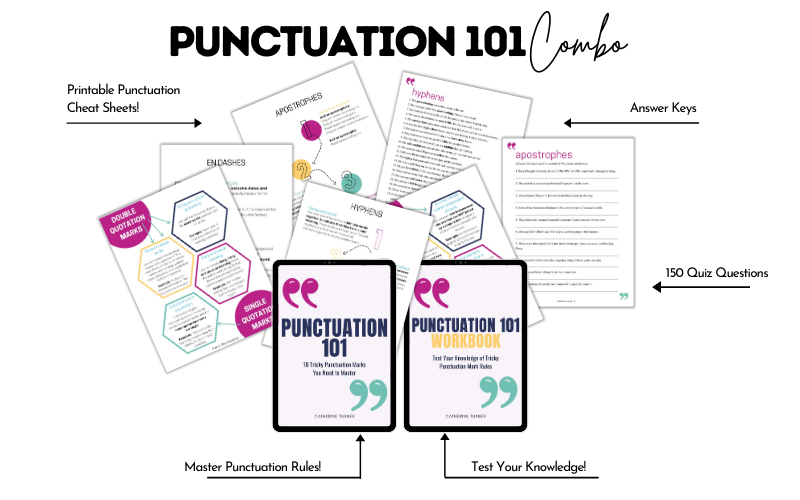
My Punctuation 101 e-book and workbook combo will help you refresh your memory of punctuation rules, learn the mistakes you need to avoid making, and polish your punctuation skills so you can wow your readers and clients.
It includes tons of example sentences so you can see the punctuation marks in action AND 150 quiz questions to help you retain that knowledge forever.
Further reading
The Associated Press Stylebook
Merriam-Webster Collegiate Dictionary
The Best Punctuation Book, Period

Hyphen quiz answers
- The prizewinning cucumbers were delicious. (Closed compound in the dictionary)
- Her teenage crush was good looking, but not very smart. (Adjective comes after the noun, so it doesn’t need a hyphen)
- The music dated from the mid-1990s, but the kids still loved it. (Hyphenate prefixes that comes before a number)
- The money-back guarantee made her feel that it was safe to invest her money. (Adjective comes before the noun, so it doesn’t need a hyphen)
- It was his first high school dance, and he was feeling kind of nervous. (Open compound in the dictionary)