

This content may contain affiliate links. If you purchase through these links I may receive a commission at no extra cost to you. However, I only recommend products or services that I genuinely like and trust.
Apostrophes are one of the most abused punctuation marks. Even the biggest grammar nerds among us sometimes add one in where it shouldn’t be used. However, they aren’t hard to master if you learn a few apostrophe rules.
Keep reading to learn how to use an apostrophe and the mistakes you should avoid.
(Please note that I used The Chicago Manual of Style (CMOS) as my reference guide unless otherwise noted.)
Table of Contents
What is an apostrophe?
An apostrophe has two main uses and one additional use that’s acceptable in certain circumstances.
The apostrophe is used to
- Indicate possession
- Stand in for omitted letters or numbers
- Form the plural of lowercase letters
You should aim to use a directional or smart apostrophe (i.e., ’ or ‘) as opposed to a straight or unidirectional mark (i.e., ‘).
How to use an apostrophe
So when should you use an apostrophe?
Let’s delve into the apostrophe rules in more detail.
Use an apostrophe to indicate possession
How you will use an apostrophe to show possession depends on whether the word is singular or plural and whether it ends in s or not.
Singular nouns not ending in s
To form the possessive of most singular nouns not ending in s, all you need to do is add an apostrophe+s.
Apostrophe examples:
The proofreader’s desk had reference books all over it.
The horse’s tail was plaited to perfection.
Singular nouns ending in s
To form the possessive of a singular noun ending in s, add an apostrophe+s.
Note: This applies even if the word ends in x, z, ce, ch, or sh.
Examples:
She stored her business’s stock in every nook and cranny in her house.
She sat in the hostess’s seat and lived to regret it.
Plural nouns not ending in s
To form the possessive of plural nouns that don’t end in s, add an apostrophe+s to the end.
Examples:
The children’s toys were strewn across the room.
Women’s rights were important to all of them.
Plural nouns ending in s
To form the possessive of most plural nouns that end in s, just add an apostrophe to the end.
Examples:
The proofreaders’ desks had reference books all over them.
The horses’ tails were plaited to perfection.
Singular proper nouns ending in s
This is a tricky apostrophe issue that confuses lot of people! Where does the apostrophe go when dealing with someone’s name that ends in s? For example, is James’ or James’s correct?
To form the possessive of a proper noun that ends in s, add an apostrophe+s.
Example:
James’s sister Catherine is the best sister a man could ask for. (I have a brother named James. ;-))
Family names
Making family names possessive is another area that trips a lot of people up. Have you ever received a holiday card with the message “Happy holidays from the Smith’s”?
Cringe!
(Here’s an in-depth look at how to make your family name plural on a holiday card.)
The basic rules of possessives outlined above apply to family names as well. For a singular, add an apostrophe+s, and for a plural, just add an apostrophe.
Singular possessive examples:
Mr. Smith’s house is the last one on the right.
Mr. Jones’s house is the last one on the left.
Plural possessive examples:
Both Brians’ dads were called John.
Note: This doesn’t mean that one man called Brian had two dads called John. Because of the s’, it means that two men called Brian both had dads called John.
What a coincidence! Both Jameses’ sisters are called Catherine.
Note: Names that end in s or letters with a similar sound often use es to form the plural.
How to use an apostrophe to indicate joint possession
Joint possession is something that trips me up all the time. (Even proofreaders have certain punctuation issues they need to look up!)
When two or more people share possession of something, only add an apostrophe+s to the final name in the list.
Example:
John and Mary’s house burned down last year. (John and Mary own the same house.)
When two or more people own something independently of each other, add an apostrophe+s to all names on the list.
Example:
John’s and Mary’s houses burned down last year. (John and Mary own two separate houses that both burned down.)
Related Content:
How to Use an Ellipsis: Chicago vs. AP Style
En Dash vs. Em Dash: When and How to Use Them
Colon vs. Semicolon: When and How to Use Them
How to Use Quotation Marks (and the Difference between Single Quotes vs. Double Quotes)
How to Use Commas (and Mistakes to Avoid)
Use an apostrophe in a contraction
An apostrophe can be used in a contraction to represent missing letters or numbers.
Examples:
He’d always wanted to go to Disneyland. (He’d is short for he had. The apostrophe represents the missing “ha” in had.)
Don’t drive down that road; it’s a one-way street! (Don’t is short for do not. And it’s is short for it is.)
She grew up in the ’80s. (’80s is short for 1980s.)
Use an apostrophe to form the plural of lowercase letters
Although using an apostrophe to form a plural is usually an error, there is a notable exception.
To aid comprehension, when making lowercase letters plural, add apostrophe+s.
Example:
Mind your p’s and q’s.
They dotted the i’s and crossed the t’s.

Apostrophe mistakes to avoid
Mistake #1: Using an apostrophe to form a plural is usually an error
Using an apostrophe to make a regular noun plural is one of the most common apostrophe mistakes.
My favorite examples of this are when you see an apostrophe being used before the final s of a plural word when fruits and vegetables are advertised in grocery stores. This is known as the greengrocer’s apostrophe!
Incorrect: Banana’s are on sale today!
Correct: Bananas are on sale today!
Avoid using an apostrophe to form the plural of a decade. It should be written as 1990s, not 1990’s.
Mistake #2: Using an apostrophe with possessive pronouns
It’s not necessary to use an apostrophe with possessive pronouns like its, yours, his, hers, ours, and theirs.
Its vs. it’s causes the most confusion. Its is a possessive pronoun that means something owns something, and it does not take an apostrophe. It’s is a contraction that’s short for it is.
Other common culprits include the following:
Whose vs. Who’s
Whose means belonging to whom.
Who’s is a contraction that’s short for who is.
Your vs. You’re
Your means belonging to you.
You’re is a contraction that’s short for you are.
Their vs. There vs. They’re
Their means belonging to them.
There means to or at that place.
They’re is a contraction that’s short for they are.
See the pattern? If the word is a contraction, use an apostrophe.
Grammar Posts
Different From vs. Different Than
Apostrophe Quiz
Identify and fix the apostrophe errors in the below sentences. You can find the answers at the end of this blog post.
- They bought the house in the 1950’s and hadn’t changed a thing.
- She picked up a dozen apple’s at the store.
- James’ homework had been eaten by the dog.
- Both of her business’s were in financial trouble.
- They hid in the womens’ bathroom until it was over.
Final Thoughts on the Apostrophe
There you have it: three simple apostrophe rules you need to follow. I hope you have a better understanding of how to use an apostrophe now and the most common apostrophe mistakes you need to avoid if you want to impress people with your writing or proofreading skills.
If you want to dive deeper into apostrophes or any other grammar and punctuation issues, check out the resources below.
Want to Learn More about Tricky Punctuation Issues?
Are you always worried that you’re not punctuating sentences correctly? Or you want to be a proofreader, but you’re worried your punctuation skills aren’t up to scratch? We all learned how to use commas, semicolons, etc. once upon a time, but information doesn’t always stick that well, and sometimes we hold on to incorrect information!
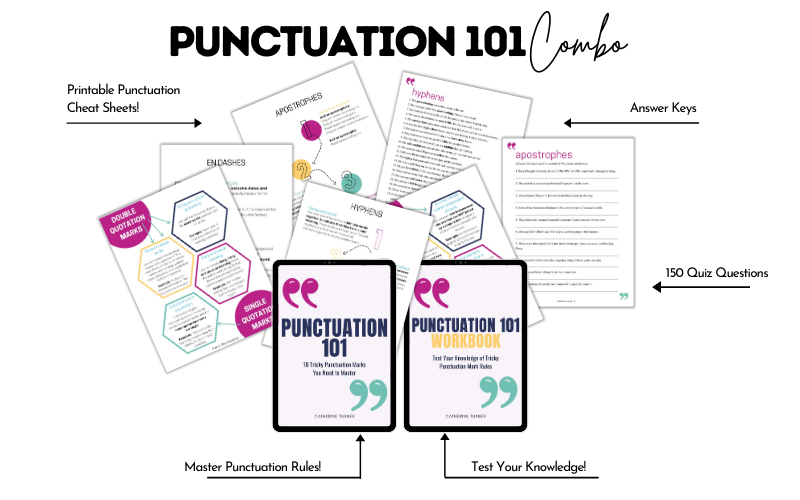
My Punctuation 101 e-book and workbook combo will help you refresh your memory of punctuation rules, learn the mistakes you need to avoid making, and polish your punctuation skills so you can wow your readers and clients.
It includes tons of example sentences so you can see the punctuation marks in action AND 150 quiz questions to help you retain that knowledge forever.
Further Reading
- The Chicago Manual of Style
- New Oxford Style Manual
- The Associated Press Stylebook
- The Best Punctuation Book, Period
Apostrophe Quiz Answers
- They bought the house in the 1950s and hadn’t changed a thing.
- She picked up a dozen apples at the store.
- James’s homework had been eaten by the dog.
- Both of her businesses were in financial trouble.
- They hid in the women’s bathroom until it was over.
Very helpful! I have a husband named James. Very difficult to remember what to do with names like that.
Thanks, Krista! It’s a tricky one all right!